



CULTURE-PROVEN INFECTIONS IN LATE PRETERM INFANTS IN A NEONATAL INFECTION SURVEILLANCE NETWORK (NEONIN)
METHODS: neonIN is an international web-based surveillance database for culture-proven neonatal infections. Cases of neonates with culture-proven sepsis from participating neonatal-units were extracted and analysed. Late-preterm neonates were defined as those with a gestational age of 33+0 to 36+6 weeks. Repeated growth of the same organism was considered the same episode if occurring within 7 days, or 10 days for Coagulase-negative staphylococci(CONS) and fungi.
RESULTS: 507 LP neonates with culture-proven sepsis were identified. Median birth-weight and a median gestational-age was of 2180g(IQR: 1750-2560) and 34 weeks(IQR:34-36) respectively. Median postnatal-age at the time of infection was 11 days(IQR:3-26). Overall CoNS was the most common pathogen accounting for 40.2%(202) of all cases. When CoNS was excluded the most common pathogen was E. coli(55,10.9%) followed by Klebsiella sp(40,8%),GBS(32,6.4%) and Enterococcus sp(38,7.6%). Characteristics of all cases as well as pathogen distribution by country are displayed on the table below.
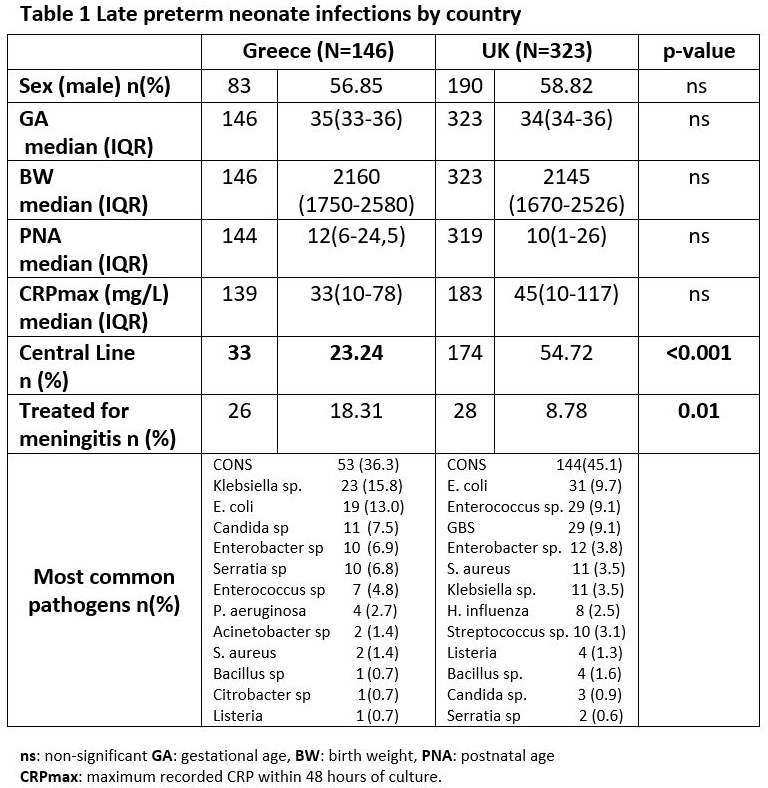
CONCLUSIONS: LP neonates are vulnerable to infection. The closed setting of the neonatal intensive-care and the immunologic immaturity of LP infants make them susceptible to nosocomial infections and they appear to have a distribution of pathogens similar to that of more preterm infants rather than that of term infants