



VACCINATION DURING PREGNANCY: WOMEN IN GREECE ARE UNAWARE AND EXPRESS CONCERNS FOR SAFETY
METHODS: This was a cross-sectional survey that was conducted with an anonymous questionnaire of 34 items on a person-to-person interview with mothers of children presented at the emergency department or hospitalized at a tertiary children’s hospital in Athens, Greece. Data collected included demographics, questions on knowledge and perceptions, and vaccination status during the last pregnancy.
RESULTS: 154 mothers of a median age of 33 years(IQR:28-37) responded to the questionnaire and 47.7% had a higher education. 125(81.2%) have given birth after 1/1/2013 and 14(11.2%) were vaccinated for flu and 1(0.08%) for pertussis. Most frequent reasons given for non-vaccination for flu and pertussis respectively, were a)unawareness (54.4%,84.8%); b)safety(34.4%,8.8%) c)their gynecologist advised them not to (13.6%,8%). Even though the majority (92.8%) believes that vaccines are beneficial, only 36.8% believe that flu vaccination is safe during pregnancy and 18.4% for pertussis with higher rates among mothers who gave birth after 2013(Table1)
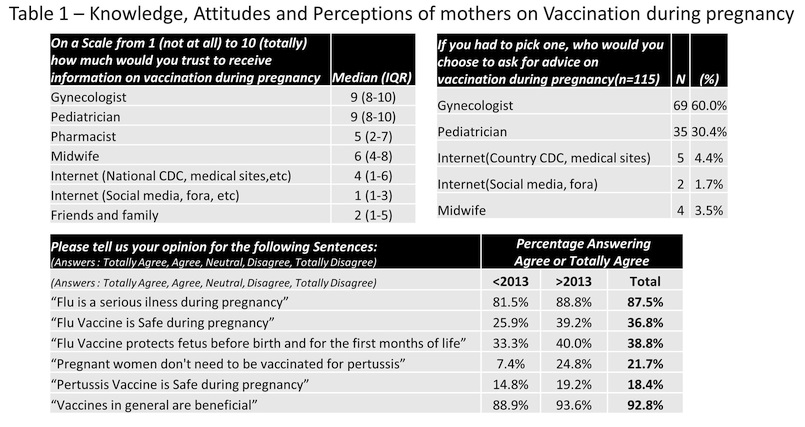
CONCLUSIONS: We detected very low rates of vaccination for flu or pertussis during pregnancy in Greece with high percentages of mothers admitting unawareness and expressing concerns on safety. The majority would trust their gynecologist for information. Education and incorporating vaccination during routine pregnancy appointments are necessary actions to improve uptake