


Healthcare-Associated and Surgical Infections Central Line Associated Bloodstream Infections in a Tertiary Referral Pediatric Cancer Center in Russia
METHODS : Active surveillance for CLABSIs was conducted for 7 months (March – September 2014) in 6 units: 3 oncology, 1 immunology and 2 bone marrow transplantation departments (BMTU). CLABSIs were prospectively identified using the Centers for Disease Control’s and Prevention National Healthcare Safety Network’s definitions. Unit-specific rates of CLABSI (per 1000 CL days) and device utilization (DU) ratios (CL days per patient days) were calculated.
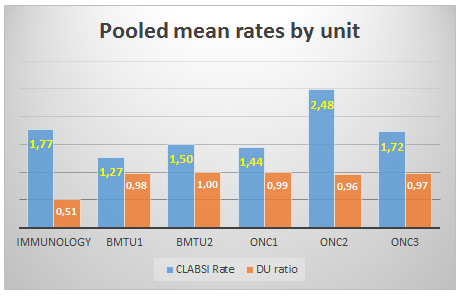
RESULTS : 47 CLABSIs were detected. Unit-specific pooled mean CLABSI rates ranged from 1.24/1000 catheter days (0.0 – 3.31/1000) in the BMTU-1 up to 2.51/1000 catheter days in the oncology-3 unit (0.0 – 8.86/1000) (Figure). DU rates varied from 0.51 (immunology department) to 1.0 (BMTU-2). The most frequent microorganisms isolated were Klebsiella pneumoniae and Achromobacter spp. (19.1% each), followed by Escherichia coli (10.6%), Streptococcus pneumoniae (8.5%) and Staphylococcus aureus (8.5%). There was an outbreak due to Achromobacter spp. from the identified single source in oncology-3 unit.
CONCLUSIONS : CLABSI rates were relatively low and similar to published data from the United States for this population with DU being high. The microbiology of CLABSI was similar as that reported in the literature.